
China’s Secret AI Weapon Is Not a Chip — It Is Electricity
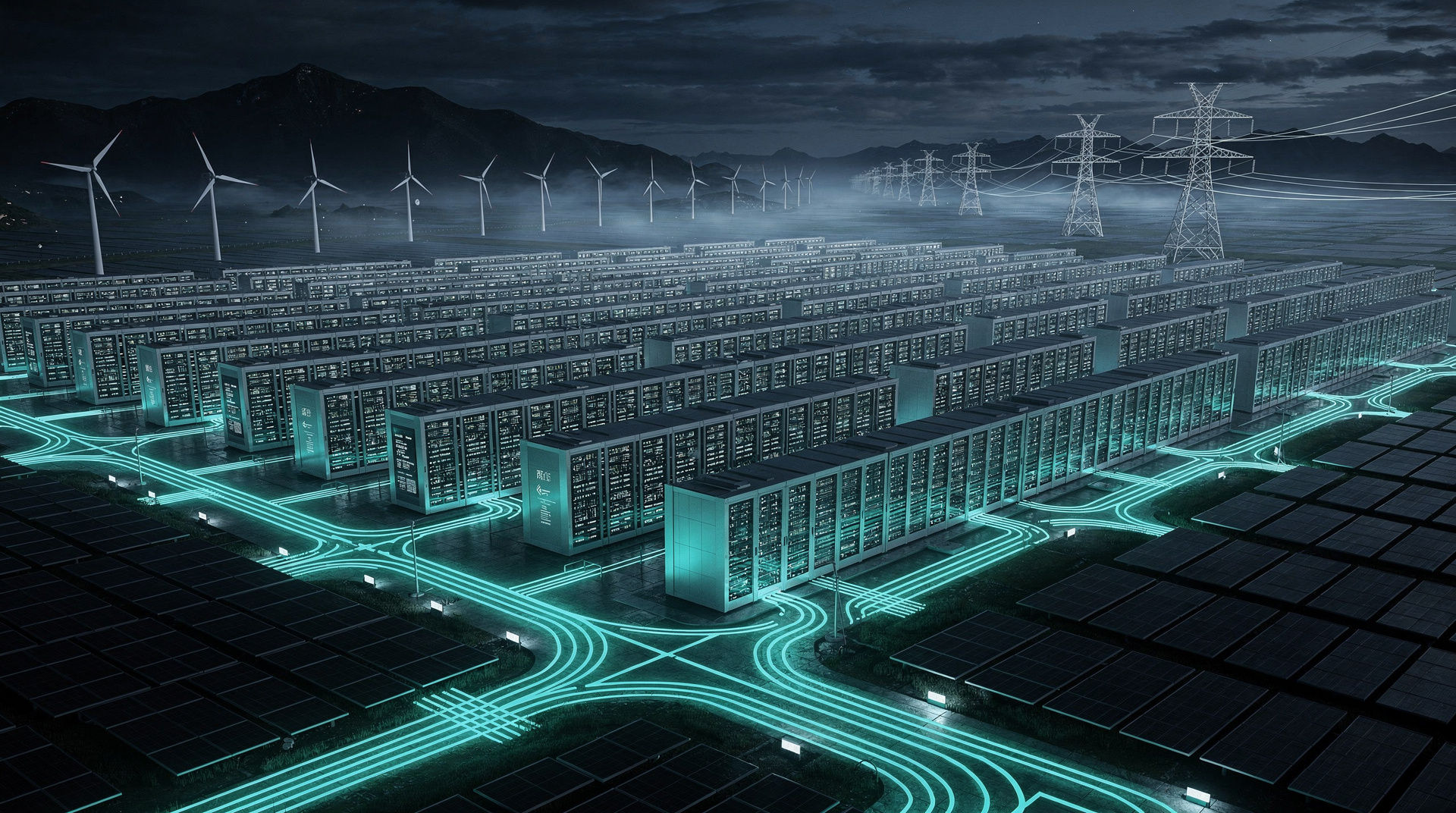
While the US struggles to power its data centers, China is building the world's most formidable AI energy infrastructure — and almost nobody is talking about it
In a nutshell
The AI race will be won by whoever controls the electricity. China already does.
Our members-only forecast calculates exactly how large China's energy cost advantage over US AI operators will be by 2028, identifies the Global South markets where Chinese AI inference will dominate within 18 months, and explains how the CATL-DeepSeek partnership could produce the infrastructure product that locks in China's data center dominance for a generation.
The Constraint Nobody Saw Coming
The global AI race was supposed to be decided by chips. By algorithms. By talent. By venture capital. It turns out the deciding factor may be something far more fundamental — and far more difficult to manufacture on short notice: electricity.
"The limiting factor for AI deployment is fundamentally electrical power," Elon Musk said at the World Economic Forum in January 2026. "Very soon, maybe even later this year, we'll be producing more chips than we can turn on — except for China. China's growth in electricity is tremendous." The statement — from the founder of both Tesla and xAI, two companies with enormous stakes in AI infrastructure — was one of the most candid admissions of structural American vulnerability to emerge from Davos in years.
The data behind Musk's observation is striking. At least 36 data centres were blocked or stalled in the United States between May 2024 and June 2025, according to Data Center Watch — held up by grid connection delays, permitting bottlenecks, and local opposition.
In China, the equivalent process encounters none of these frictions. When Beijing decides to build AI infrastructure, it builds it — at a pace and scale that the United States' fragmented, privatised energy grid structurally cannot match.
A Doubling of Capacity by 2030
The numbers describing China's data center buildout are almost difficult to process. China is on course to nearly double its data center capacity within five years, with 28 gigawatts of new projects expected to come online by 2030, adding to the 32 gigawatts already installed at the end of last year. Installed capacity is already projected to reach 40 gigawatts by end of 2026 — up from 32 gigawatts just twelve months ago.
The demand driving this buildout is accelerating rather than stabilising. Data centers posted a 38% compound annual growth rate over the past five years in China and are forecast to maintain a 19% annual growth rate through 2030 — making them the fastest-growing source of power demand in the entire Chinese economy. AI and high-performance computing facilities already account for 39% of installed data center capacity in China, rising to a projected 48% by 2030 — a share that reflects how completely the buildout has pivoted from general-purpose computing toward AI-specific infrastructure.
The strategic architecture underpinning this expansion is equally deliberate. China's "East Data West Computing" strategy, launched in 2022, established eight major computing hubs specifically designed to ease pressure on land and energy in the densely populated east, with clusters emerging in renewable-rich western regions — a planned national computing grid that has no equivalent anywhere in the Western world.
Renewable Energy as an AI Superpower
China's energy advantage is not merely a matter of political will — it is grounded in a renewable energy buildout of extraordinary scale. In the first half of 2025 alone, China installed 357 gigawatts of new wind and solar capacity — an amount greater than the entire installed power capacity of India. New data centers in China are expected to source over 80% of their electricity from renewables — giving China the rare combination of cheap, clean, and abundant power precisely when AI's appetite for electricity is growing fastest.
The commercial consequence of this energy architecture is already visible in the global AI market. In February 2026, Chinese AI models surpassed US models for the first time in weekly token usage on OpenRouter — a major AI model API aggregation platform.
The electricity powering those computations never left China. But the value it created — packaged in AI tokens and sold to users across the globe — did. China has, quietly and almost without notice, begun exporting artificial intelligence the way it once exported manufactured goods: at scale, at low cost, and with a structural energy advantage that competitors will take a decade to close.
Sources: Al Jazeera, Rystad Energy, OilPrice.com, Brookings Institution, IEA, iChongqing, EIU / AI Proem
Strategic Analysis — For Members Only
🔒 This analysis is for watchchina.ai Intelligence members only.
Already a member? Log in here