
China’s Quantum Computer Can Now Break — and Build — the World’s Most Secure Encryption
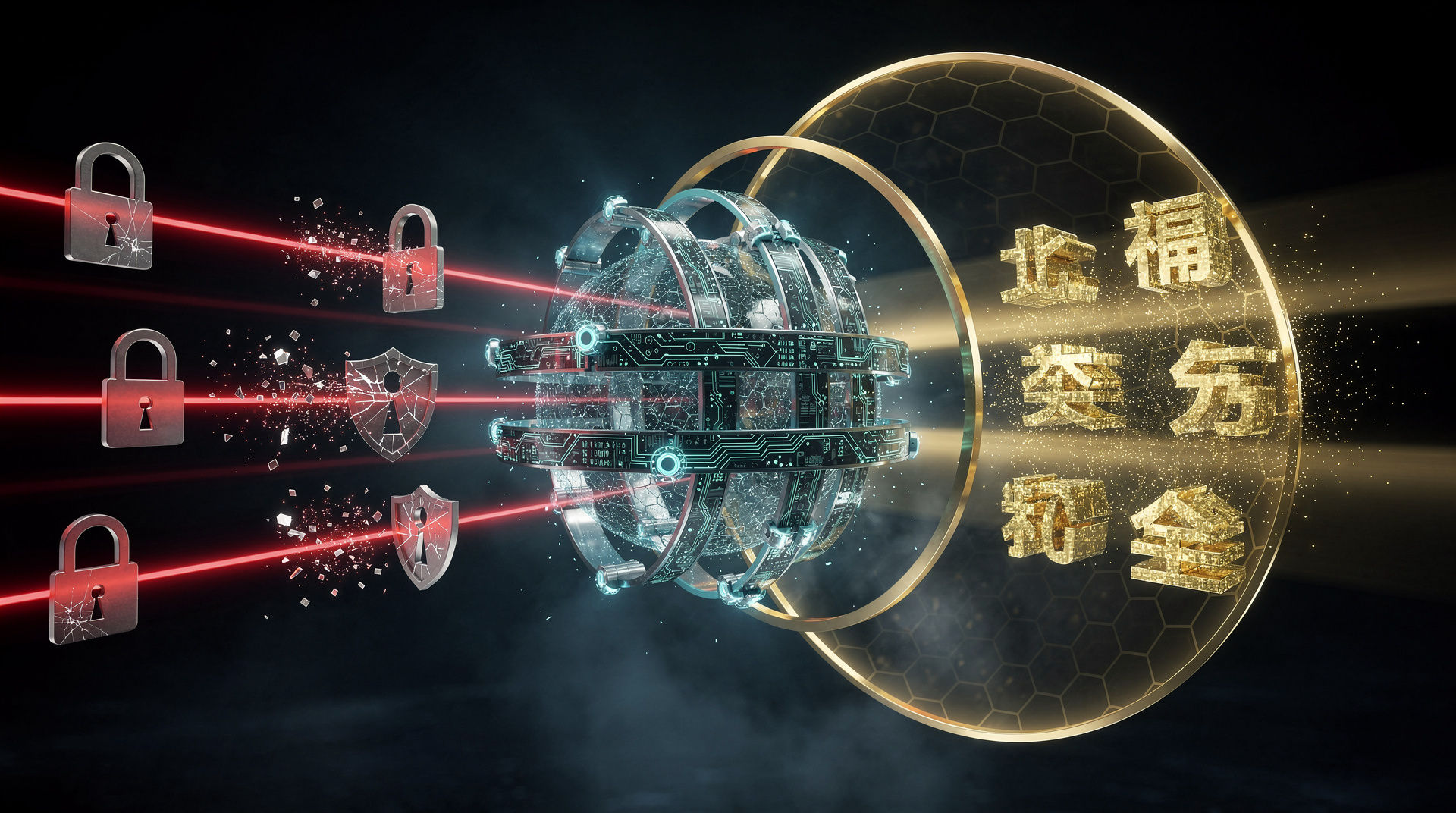
Origin Wukong's "spear and shield" breakthrough positions Beijing to simultaneously crack Western cryptography and make its own unbreakable — within three years
In a nutshell
China's quantum computer attacks Western encryption and defends Chinese data — simultaneously. The three-year timeline to global PQC standards is now official.
Our members-only forecast maps the cryptographic bifurcation coming for every multinational operating in China, explains how China's space-earth quantum network will blind Western intelligence agencies by 2029, and identifies why the nine-qubit AI breakthrough could make today's $295 billion data centre buildout partially obsolete within a decade — and what that means for every investor currently betting on classical AI infrastructure.
A 72-Qubit Machine With a Historic New Capability
On June 17, 2026, a quiet but extraordinary announcement emerged from Hefei, China. Origin Wukong — China's third-generation superconducting quantum computer, a 72-qubit system that has already completed over one million computing tasks — successfully integrated a post-quantum cryptography security framework. The system, featuring the Origin Rock cryptographic module, now provides what its developers describe as a "spear and shield" computing service: the spear capable of attacking conventional encryption systems, the shield capable of protecting sensitive data against both quantum and classical decryption attempts simultaneously.
The implications of this dual capability are difficult to overstate. Conventional encryption — the RSA and elliptic-curve systems that protect banking transactions, military communications, government records, and virtually every private message sent over the internet — relies on the practical impossibility of factoring large numbers using classical computers. A sufficiently powerful quantum computer breaks that assumption entirely.
China's Origin Wukong is not yet at that threshold. But its successful integration of post-quantum cryptography architecture — combined with the 15th Five-Year Plan's explicit target of establishing national post-quantum cryptographic standards within three years — signals that Beijing is preparing for a world in which quantum decryption becomes operational, and intends to be ready with quantum-resistant infrastructure before anyone else is.
Nine Quantum Spins That Outperform a $100 Million AI Supercomputer
The cryptography announcement arrived in the same month as a second, equally striking quantum breakthrough from Chinese researchers. A joint team from the University of Science and Technology of China and the Chinese University of Hong Kong demonstrated that a small-scale quantum system built on just nine interacting quantum spins matched or exceeded the performance of a classical reservoir network with 10,000 nodes in multi-step weather prediction tasks — at less than one percent of the cost of the classical alternative.
An AI computing centre capable of predicting weather patterns weeks in advance typically carries a price tag of $100 million or more.
The Chinese quantum system achieved comparable performance for a fraction of that investment. The findings raise a question that could reshape the entire global AI infrastructure conversation: if compact quantum systems can deliver competitive performance in specific high-value tasks, could the colossal data centre investments currently underway — including China's own $295 billion AI buildout — eventually be rendered obsolete by quantum systems that cost a fraction as much? China appears to be the only country building both infrastructure paths simultaneously, hedging its bets across classical and quantum AI at national scale.
The 15th Five-Year Plan: Quantum as Priority Number One
The context surrounding these breakthroughs is as important as the breakthroughs themselves. China's 15th Five-Year Plan — covering 2026 to 2030 — names quantum technology first among seven strategic "future industries," ahead of AI, 6G, humanoid robots, brain-machine interfaces, and nuclear fusion. The plan's key targets include fault-tolerant general-purpose quantum computers, scalable special-purpose quantum systems, and an integrated space-earth quantum communication network — a satellite-linked quantum encryption grid covering the entire country and potentially extending to Belt and Road partner nations.
The National Venture Guidance Fund has allocated 121.8 billion yuan across three regional vehicles specifically targeting quantum commercialisation — in Beijing for quantum computing and sensing, in the Yangtze River Delta for quantum communications and industrial applications, and in the Guangdong-Hong Kong-Macao region for commercial products. China Telecom Quantum Group, which became the controlling shareholder of QuantumCTek in January 2025, is consolidating quantum cryptography and computing capabilities under a single state-owned entity with over 10 billion yuan in planned investment. Huawei, facing US chip export restrictions, has dramatically expanded its quantum research programme as a parallel path to computing self-sufficiency.
The race is no longer only about AI. It is about who controls the cryptographic infrastructure of the next century.
Quantum Computing Report, CSIS, The Quantum Insider, CKGSB Knowledge, South China Morning Post, Anablock AI
Strategic Analysis — For Members Only
🔒 This analysis is for watchchina.ai Intelligence members only.
Already a member? Log in here