The Quiet Surrender: America Wanted Asia to Use Its AI — But It Stopped Showing Up
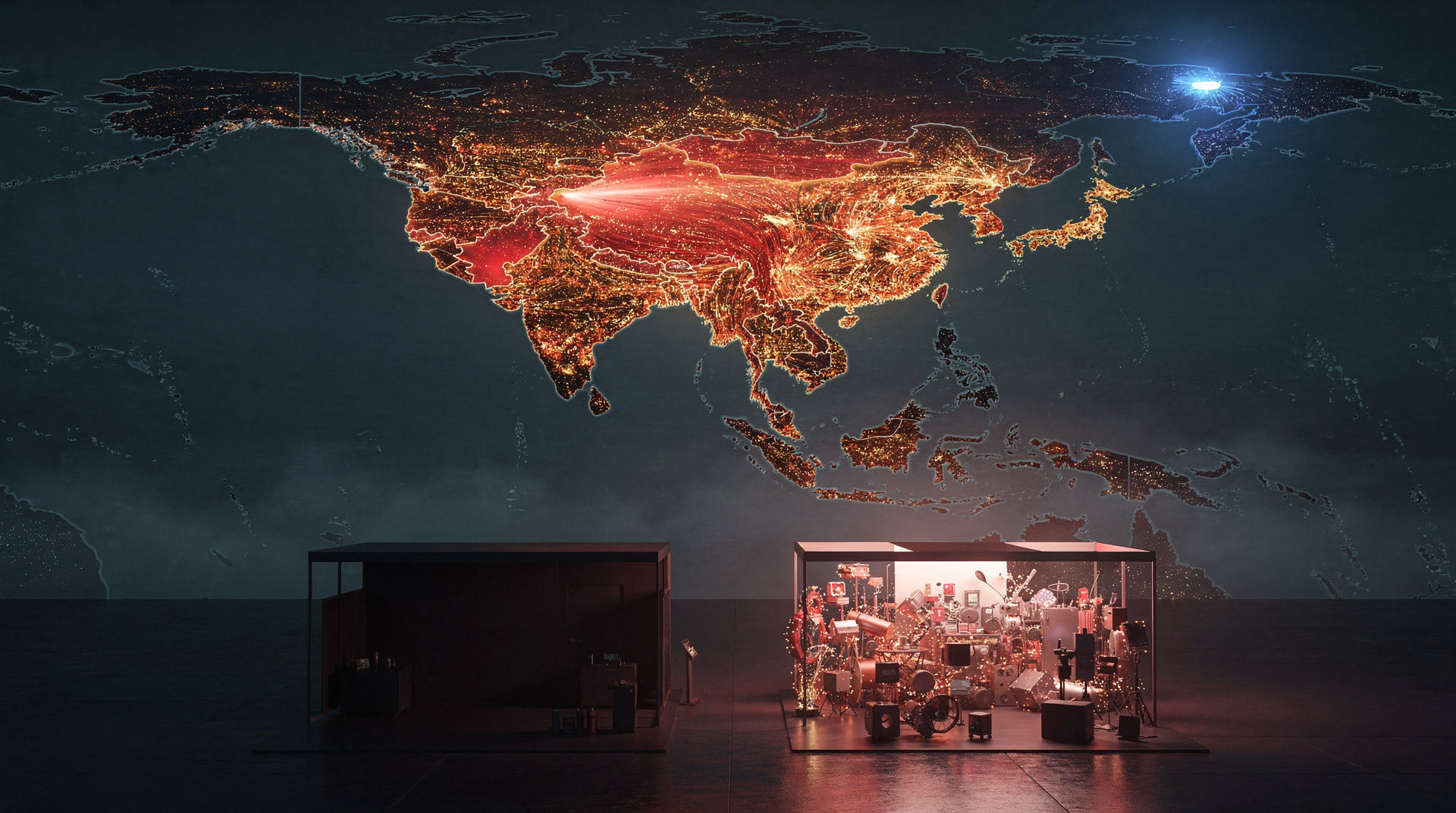
Between two APEC meetings, Washington went silent while China flooded the continent with cheap models. Even Google's Chengdu booth didn't lead with Gemini. This is what losing a market looks like in real time
In a nutshell
America wanted Asia to use its AI — then went quiet and raised its walls. Even Google didn't lead with Gemini in Chengdu. This is what surrendering the world's largest AI market looks like.
Our members-only forecast explains why China will lock in majority AI market share across Southeast Asia by 2027 before Washington can respond, why even US firms like Google will quietly hedge toward Chinese-model compatibility, and why "quiet America" is set to become Washington's defining strategic failure — and a bipartisan political issue — within a year.

The Battleground That Matters Most
Throughout this series, watchchina.ai has argued that the decisive front in the AI race is not the frontier lab or the benchmark leaderboard — it is diffusion, the contest to become the default AI across the developing world. This week, that abstract thesis acquired a concrete geography: Asia, the largest and most populous continent on Earth, where the outcome is being decided not by who has the smartest model, but by who bothers to show up.
The artificial intelligence race between the U.S. and China is heating up in the world's largest continent: Asia. And the trajectory is unmistakable. The U.S. has launched an export program and other initiatives to bolster American AI in Asia — but between the first APEC AI meeting and the second, the U.S. has grown noticeably quieter, while Chinese companies have ramped up cheaper alternatives to American AI, and Beijing promotes its tech internationally. The American strategy, as one observer summarized it, is to stop China from becoming the leading AI supplier for the rest of Asia. On the evidence of the past months, that strategy is failing — not because America was outcompeted on technology, but because it stopped competing for attention.
The Detail That Says Everything
Sometimes a single image captures a strategic reality more precisely than any statistic, and watchchina.ai found it in the coverage of APEC Digital Weeks in Chengdu. Google's display at APEC Digital Weeks in Chengdu on July 23, 2026 did not focus on Gemini. Read that again. At a major Asian technology forum, hosted in China, America's flagship AI model — Google's Gemini, one of the most capable systems on Earth — was not the centerpiece of Google's own booth.
This is the diffusion defeat made visible. As watchchina.ai has documented from the "good enough" strategy to the 140-trillion-token explosion to WAICO's 29 founding nations, China's advantage was never about winning the benchmark war. It was about presence, price, and availability — being the AI that is actually there, actually affordable, and actually usable when a developer in Jakarta, Manila, or Bangkok sits down to build. When even Google chooses not to lead with its frontier model at an Asian forum, it signals that the terms of competition have shifted decisively onto China's ground: the ground of accessibility rather than capability. America can build the better model and still lose the market, because the market was never buying "better." It was buying "available."
Why Silence Is the Fatal Strategy
The deeper lesson, the one watchchina.ai has returned to across dozens of briefings, is that in a diffusion contest, absence is defeat. China's whole approach — cheap open models, training programs, infrastructure investment, WAICO membership, Xi personally courting the Global South — is fundamentally a strategy of showing up, relentlessly, everywhere, with a concrete offer. America's approach has increasingly been the opposite: restrict, suspect, wall off, and, as this week reveals, go quiet in the very forums where the future is being decided.
The contrast is being reinforced from every direction watchchina.ai has tracked. This week alone, China's Moonshot AI raised $3.5 billion — 1.75 times its target — at a $35 billion valuation, on the strength of its open-weight Kimi models, while Anthropic faced headwinds across Silicon Valley as the only frontier company that did not sign an industry-wide open-weights support letter. The capital markets, the developer communities, and now the Asian governments are all converging on the same signal: openness and availability are winning, restriction and absence are losing. None of this means America's technology is inferior — its frontier models remain formidable, as watchchina.ai has consistently acknowledged. But technological superiority is worthless in a market you have stopped contesting. Washington wanted Asia to use American AI. Then it went quiet, raised its walls, and left the field. And into every space America vacated, China arrived — cheaper, open, and present. This is not what losing a technology looks like. It is what surrendering a market looks like, one unattended forum at a time.
Sources: CNBC, note.com AI roundup, Bloomberg, South China Morning Post
Strategic Analysis — For Members Only
🔒 This analysis is for watchchina.ai Intelligence members only.
Already a member? Log in here