
The DeepSeek Engineer Teaching AI to Replace Him — What the Viral Version Gets Wrong
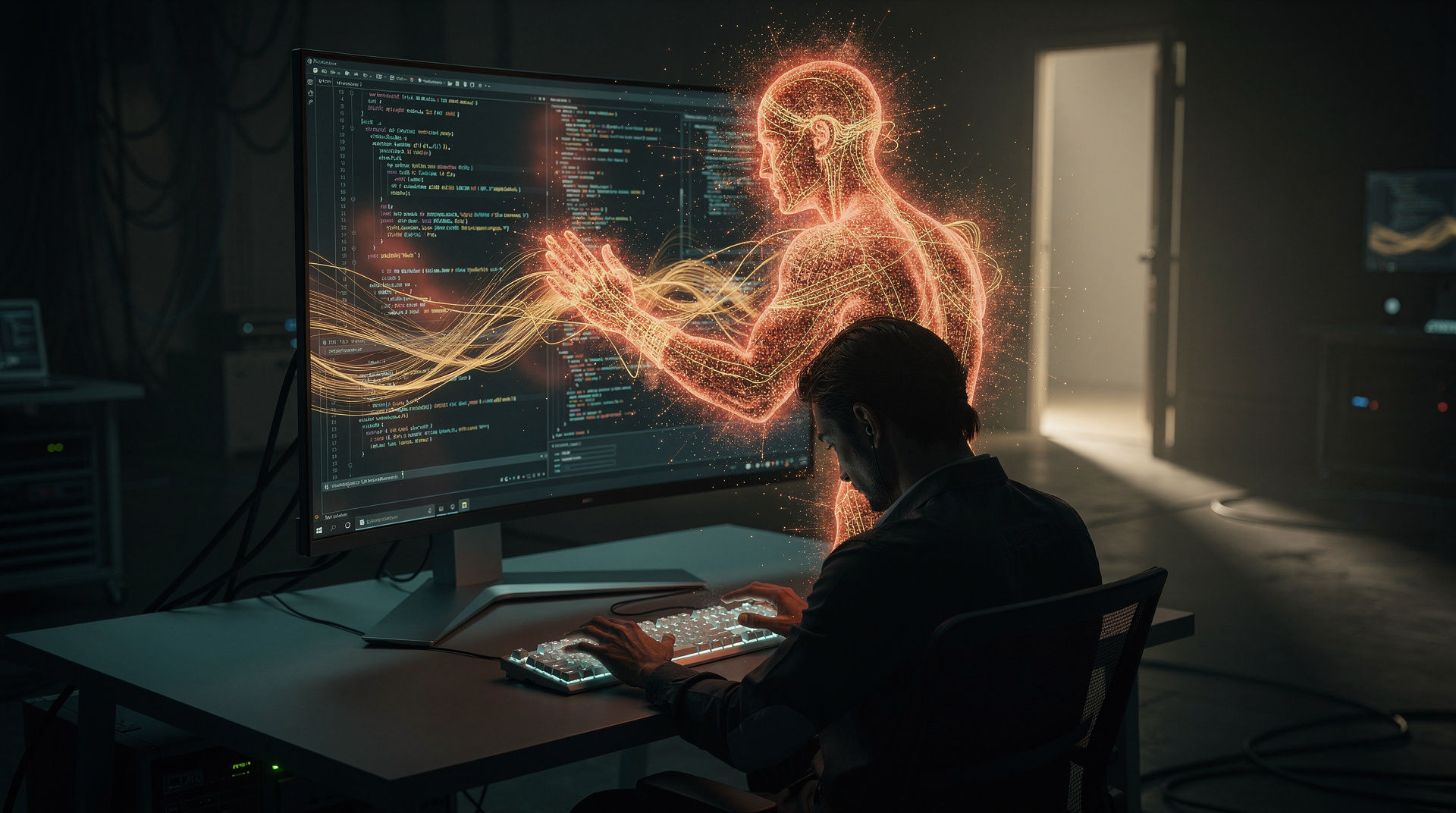
A post claiming "AI now improves itself" hit number one in China and swept the West. The real essay is quieter, sadder, and more revealing than the headline — a craftsman saying goodbye to the work he loves, even as he keeps building the thing that will end it
In a nutshell
"AI is improving itself now" is going viral — built on a real DeepSeek engineer's essay he says means the opposite. The truth is an elegy for lost craft, and a rare window into why top talent chooses China's open labs.
Our members-only forecast explains why AI-assisted kernel engineering will amplify China's efficiency edge within a year, why the "obsolescence of mastery" fear will become a theme Beijing manages carefully, and why open-weight idealism remains a genuine talent magnet for Chinese labs — even as the commercial strings quietly tighten.

The Viral Claim, and the Real One
For seventy-three briefings, watchchina.ai has held one discipline above all: separate the signal from the noise, and never let a real story be inflated into a false one. A post is circulating now in a dramatic frame — "It begins: AI is improving itself. A DeepSeek researcher says within a year, AI will write the code that makes AI faster better than he can." The underlying facts are real. The framing distorts what actually happened, and the truth is more interesting than the hype.
Here is what is genuine. Liu Shengyu, a machine-learning-systems engineer at DeepSeek who joined in April 2025, wrote the main attention kernel for DeepSeek V4.1-Flash, released in mid-September. Days later he published a personal essay on his WeChat blog. It hit number one on Zhihu — China's largest knowledge platform — drew more than 100,000 reads, and was translated into English and Japanese. The quote at the center is real: he wrote that in another six months to a year, AI will most likely write kernels as well as he does, or better. A kernel, for readers who don't live in this world, is the low-level code that makes a model compute efficiently — and Liu writes exactly the kind of code that makes DeepSeek's models run faster. So yes: an elite engineer at China's most famous lab believes AI is close to matching him at the very work that improves AI. That much the viral version gets right.
What the Headline Strips Away
But watchchina.ai's job is to read the primary source, and the essay is almost the opposite of the triumphant "AI improves itself now" banner draped over it. Its title is "I Have No Choice but to Bury My Talent in Yesterday." It is an elegy, not an announcement — a craftsman's melancholy farewell to work he genuinely loves. Liu describes optimizing kernels until they beat FlashAttention and Nvidia's own implementations, and he compares the pleasure of it to playing a video game. The emotional core is loss: he will keep his job, he expects, but lose the part of it that gave him joy. Journalists, in his own words, "read geopolitics into a piece about craft."
And Liu was unusually explicit about the two misreadings his essay would attract — both of which the viral version commits. He wrote plainly that his purpose was "not to express anxiety about unemployment, and even less to stress DeepSeek's openness and Anthropic's unpleasantness." Read that again, because it matters: the engineer himself pre-emptively rejected both the "AI is coming for your job" panic and the "China-open versus America-closed" framing that Western coverage promptly stapled onto him. watchchina.ai will honor what he actually said rather than what makes the better headline. This is not a manifesto about machines seizing control of their own improvement. It is one skilled human being, at the frontier, mourning the obsolescence of a craft he mastered — and choosing, with clear eyes, to keep accelerating the very thing that will retire it.
The Real Significance — Quieter and Larger
So is there nothing to the "self-improving AI" reading? Not quite — and here watchchina.ai will give the viral instinct its due, carefully. Liu's testimony is genuine evidence that AI is beginning to meaningfully contribute to the work of building better AI. He describes AI moving, in roughly a year, from a tool that checked documentation and spotted bugs to one that reads GPU code and optimizes the operators that make models faster. That is a real and significant trend, and independent work points the same way: separate research teams this year have used AI agents to generate GPU kernels that beat expert baselines in open contests. The loop where AI helps make AI more efficient is real and tightening. What it is not — yet — is the fully autonomous, human-free recursive self-improvement that the dramatic framing implies. Liu is not describing a machine improving itself in the night. He is describing himself, a human, using AI to do his job faster, until the AI can do that job without him. The distinction matters, and watchchina.ai keeps it.
The deepest layer is the one that connects to everything this portal has tracked about the two AI superpowers. Liu explained why he stays at DeepSeek despite building his own obsolescence, and his reasoning is the actual geopolitical content of the essay — not the manufactured "China good, America bad" version, but something more sober. He wrote that he fears a future where a few companies control the most advanced AI while everyone else makes do with feeble tools — a "Cyberpunk 2077" outcome, as he put it — and that he chose DeepSeek because it builds powerful AI and open-sources it, which he believes pushes against that concentration. One can agree or disagree with his faith in open weights as a safeguard; watchchina.ai has documented all year that China's "openness" is also a competitive weapon acquiring commercial strings. But his stated motive is a genuine window into why talented people choose China's frontier labs: not nationalism, but a conviction — sincere or self-serving — that open, accessible AI is the safer path. That is the real story under the viral one. A gifted engineer, teaching the machine to replace him, because he would rather that machine be open to everyone than locked in the hands of a few. It is sadder, stranger, and more human than "AI improves itself now" — and, as almost always, the quieter truth is the one worth reading.
Sources: 36Kr, China Research Collective, ChinaTalk, Yahoo News (Business Insider), Geopolitechs, The X-Pin, Liu Shengyu's WeChat essay (translated)
Strategic Analysis — For Members Only
🔒 This analysis is for watchchina.ai Intelligence members only.
Already a member? Log in here