
DeepSeek Goes to Space: China Is Building an AI Supercomputer in Orbit
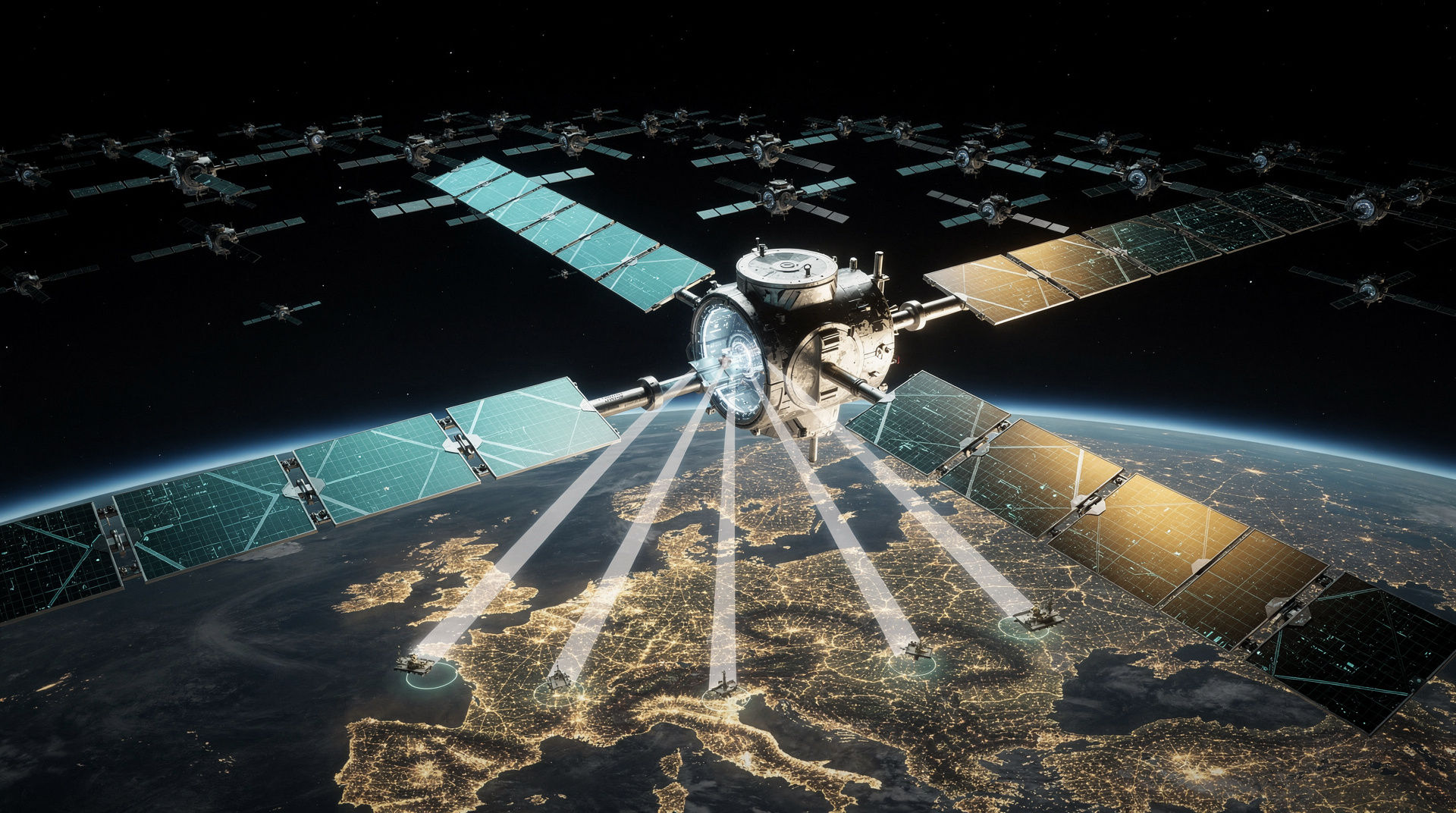
From surveillance satellites to orbital data centers — China is quietly winning the race for the final frontier of AI computing
In a nutshell
China has 203,000 satellites registered. DeepSeek is already running in orbit. Iran is using Chinese space AI to target US military assets.
Our members-only forecast explains why MizarVision will be sanctioned within months and what China does next, maps the 2029 timeline for Chinese orbital AI dominance, and details why China's ITU satellite registration is the most consequential geopolitical land grab since the South China Sea — and why almost nobody in the West is paying attention.
The World's First AI Satellite — Running DeepSeek
On February 12, 2026, a Jielong-3 carrier rocket launched from the South China Sea carrying seven satellites into orbit. One of them was unlike anything that had ever been placed in space before.
CUHK No.1 — developed with the Chinese University of Hong Kong — is the world's first AI large-model satellite designed for urban sustainable development, and the first satellite in history to deploy the DeepSeek large language model in orbit, enabling it to identify targets and extract features from multispectral data directly in space — shifting from simply collecting raw data to producing usable intelligence without ever downlinking to a ground station.
The implications of that distinction are profound. Every previous Earth observation satellite was, in essence, a very expensive camera: it captured data and sent it to the ground for processing. CUHK No.1 processes its own data in orbit, in real time, using one of the world's most capable AI models. The satellite does not just see — it understands what it sees.
The Three-Body Computing Constellation: A Supercomputer Above the Clouds
CUHK No.1 is the most visible symbol of a far larger architectural ambition. China has advanced its vision for space-based computing with a satellite network — the Three-Body Computing Constellation — that deploys ten artificial intelligence models in orbit and demonstrates inter-satellite networking capabilities. The first twelve satellites of the constellation were launched in May 2025, and after nine months of on-orbit testing have successfully demonstrated inter-satellite connections, AI model operation, data processing, and scientific instrument integration.
The constellation's planned scale is staggering. ADA Space is set to triple the size of its Three-Body Computing constellation in 2026, with further satellite deployments planned for 2027 — and China's state-owned aerospace giant, the China Aerospace Science and Technology Corporation, has explicitly included gigawatt-scale space-based digital and intelligent infrastructure in its 15th Five-Year Plan targets for 2026 to 2030. In other words: China is not building a handful of experimental AI satellites. It is building a national strategy for orbital computing infrastructure.
Spying on US Military Bases — From Space, in Real Time
The military dimension of China's AI satellite programme is already operational — and deeply alarming to Western defence establishments. A Chinese company, MizarVision, has released AI-processed satellite imagery of US military bases and naval assets, with some images appearing shortly before US and Israeli strikes on Iran — showing Lockheed Martin F-22 Raptor jets at Israel's Ovda air base, support aircraft at Prince Sultan Air Base in Saudi Arabia, and activity aboard the USS Gerald R. Ford as it departed Souda Bay in Crete.
Officials from the Defense Intelligence Agency assessed that Iran's Islamic Revolutionary Guard Corps is using MizarVision's datasets to improve planning of missile and drone attacks — analyses conducted in near real time.
The strategic significance of this capability cannot be overstated. Real-time AI-processed satellite intelligence, commercially available and already being used by adversaries of the United States, represents a fundamental shift in the global intelligence landscape. "Whoever first masters mature on-orbit real-time capabilities in perception, cognition, and decision-making will seize the strategic initiative in the space era — a contest that directly affects national security and the right to shape future development," said Han, the program leader of China's space AI initiative, adding that the competition is no less profound than the global positioning satellite race of decades ago.
Mass Production: China's Commercial Space Boom
The technology layer is supported by a commercial space manufacturing base that is scaling at extraordinary speed. China's commercial space sector recorded 50 launches in 2025, accounting for 54% of all national space launches — with 311 commercial satellites successfully placed in orbit, representing 84% of China's total satellites.
China has also applied to register up to 203,000 additional satellites with the International Telecommunication Union — a number that would, if fully deployed, give China orbital infrastructure rivalling or exceeding anything currently operated by Western commercial or government entities.
Sources: GlobalSecurity.org / Global Times, Space Daily, Orbital Today, Military Watch Magazine, Defence Industry EU, China-in-Space.com, VOI / China Daily
Strategic Analysis — For Members Only
🔒 This analysis is for watchchina.ai Intelligence members only.
Already a member? Log in here