
Washington’s Alarm Is Now Official: Chinese AI Is a Serious and Growing National Security Threat
A new CNAS report names the risks — coding, reasoning, bioweapons, cognitive warfare — and warns the threat is accelerating
In a nutshell
80% of US startups are building on Chinese AI. Washington just called it a national security threat.
Our members-only forecast maps the emergency restrictions likely to hit Chinese base models within 12 months — and what forced migration means for thousands of American companies — identifies the AI influence operation that could define the 2026 midterm cycle, and explains why China will use the Shanghai AI conference to pre-empt Western bioweapons AI restrictions. All inside.
From Concern to Verdict
For years, warnings about Chinese AI as a national security threat circulated in policy circles, think tanks, and classified briefings. Today, that concern has crystallised into a formal, public verdict. A major new report from the Center for a New American Security — one of Washington's most influential defence-focused think tanks — leaves no ambiguity about its conclusions.
The report, titled "Red Lines: Understanding the National Security Risks of China's Advanced AI," and written by CNAS senior fellow Daniel Remler, warns that at least seven Chinese developers now produce AI systems with powerful capabilities including coding, reasoning, multimodal recognition, and agentic tasks — all downloadable by anyone in the world.
The open availability of these systems is central to the report's concern: unlike classified military hardware, Chinese frontier AI models can be accessed, adapted, and weaponised by state and non-state actors globally without restriction.
Four Threat Vectors — Each Serious on Its Own
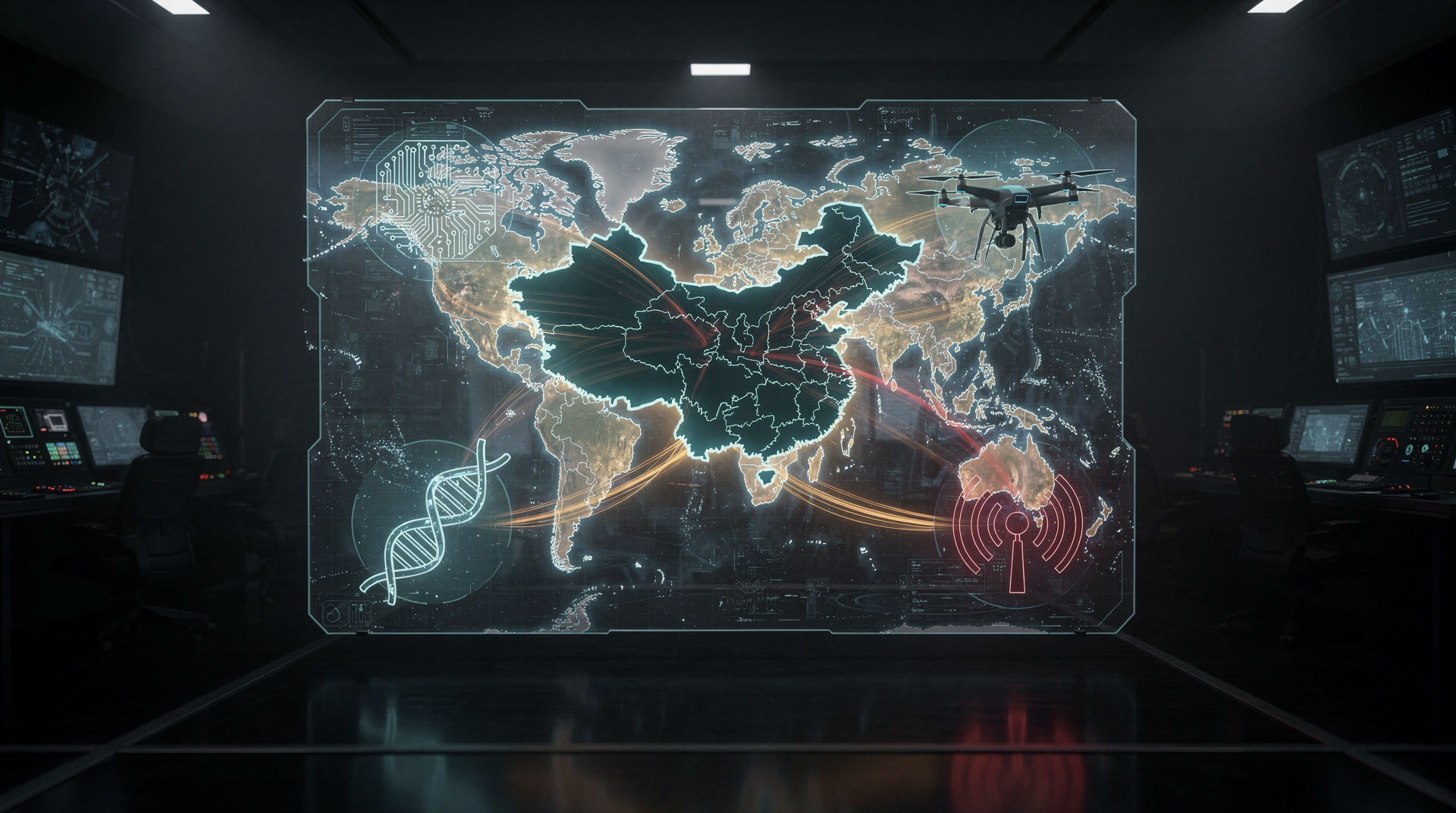
The CNAS report maps China's AI national security threat across four distinct dimensions, each of which would constitute a serious policy challenge in isolation. Together, they represent a threat landscape of extraordinary breadth.
Kinetically, Chinese AI is enhancing military capabilities and offensive cyber operations. It is also fueling concerns about Beijing's use of AI for biological weapons development. Chinese cognitive warfare programmes are being powered by AI through more effective censorship, surveillance, and influence campaigns. And AI is enabling more effective espionage.
The biological weapons dimension is the most alarming. As watchchina.ai has previously reported, China's AI-powered drug discovery capabilities — including Insilico Medicine's ability to develop new compounds in under 18 months at a fraction of conventional costs — represent a dual-use capability that is structurally difficult to distinguish from legitimate medical research. The same computational biology infrastructure that accelerates cancer drug discovery can, in principle, be directed toward the design of novel pathogens.
The Open Ecosystem as a Strategic Weapon
Perhaps the most counterintuitive finding in the CNAS report is its treatment of China's open-source AI strategy as a security threat in itself. A partner at US-based venture capital firm Andreessen Horowitz estimated that approximately 80% of US startups use Chinese base models to develop derivatives for their own businesses — with even larger companies like Airbnb using Alibaba's Qwen model for customer-facing applications.
The implication is stark: China's open AI ecosystem has achieved deep penetration into the American technology industry — not through espionage or coercion, but through the straightforward competitive advantage of high-quality, freely available models.
The Chinese Communist Party, which collapses the boundaries between state, military, and private sector, treats these AI systems as instruments of political control, economic domination — and, the CNAS report argues, national security projection. Every American startup building on a Chinese base model is, to some degree, building on infrastructure whose ultimate loyalties are not commercially neutral.
Sources: Washington Times, CNAS, US-China Economic and Security Review Commission, Andreessen Horowitz research
Strategic Analysis — For Members Only
🔒 This analysis is for watchchina.ai Intelligence members only.
Already a member? Log in here