
China’s Military AI: Robot Dogs, Nvidia Chips, and the Future of Warfare
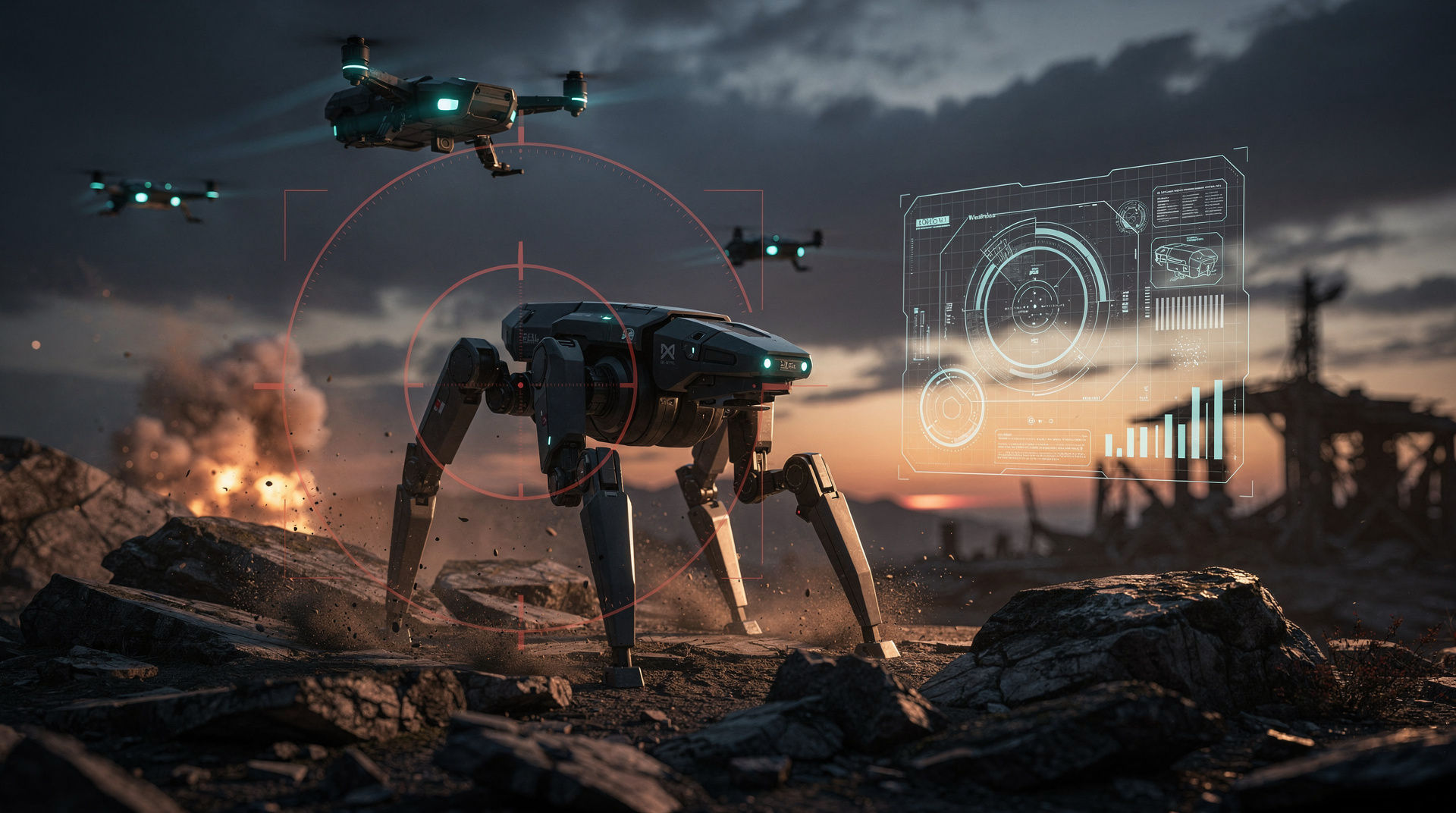
Beijing's "intelligentised warfare" is no longer a concept — it is a field reality
In a nutshell
Armed Robots on the Battlefield — No Longer Science Fiction
In the deserts of Inner Mongolia, China recently offered the world an unambiguous glimpse of its military future. During the Steppe Partner 2026 exercises with Mongolia, soldiers, autonomous systems, and AI-assisted command structures operated together as parts of a single integrated ecosystem — with armed robotic quadrupeds moving alongside troops as a standard element of battlefield formation. What military strategists in Beijing call "intelligentised warfare" has moved from doctrine to deployment.
The hardware is not merely experimental. At the World Defense Show 2026 in Riyadh, a Chinese state-linked manufacturer introduced the PF-070 — a four-legged combat robot armed with four anti-tank guided missiles, described as a production-ready platform designed for international sale. The robot uses an acoustically quiet chassis capable of engaging targets up to four kilometers away, and has been tested in breach-and-clear drills, including airdrop operations from drones. China is not just building these systems for its own forces — it is selling them.
Nvidia's Chips at the Heart of the Controversy
Behind the battlefield hardware lies a critical and increasingly political question: where is the computing power coming from? A Bloomberg investigation has revealed that at least seven Chinese universities with close ties to the People's Liberation Army are seeking access to Nvidia's H200 chips — the most powerful AI processors ever permitted by the US government to be sold in China. Two of the institutions — Beihang University and Northwestern Polytechnical University — rank among China's "Seven Sons of National Defense," an elite group explicitly dedicated to supporting the PLA.
The findings land at a moment of acute political sensitivity. Nvidia CEO Jensen Huang has been invited to testify before the US Senate Banking Committee on June 11, as lawmakers warn that advanced American chips could be used by China to strengthen its military and surveillance capabilities. The hearing will force a direct confrontation between the commercial interests of America's most valuable semiconductor company and the national security imperatives of the US government.
A Civilian Industrial Base Fueling Military Power
China's military AI advantage is inseparable from its civilian manufacturing dominance — and that convergence is accelerating. According to the International Federation of Robotics, China's operational robot stock exceeded two million units in 2024, with roughly 295,000 new robots installed that year compared to just 34,200 in the United States. That industrial scale feeds directly into military capability — providing both the manufacturing base and the real-world training data needed to develop combat-ready autonomous systems.
A February 2026 report from Georgetown University's Center for Security and Emerging Technology, analyzing thousands of PLA procurement documents, found that China's military is pursuing AI-enabled capabilities across all domains — including decision support systems, sensor enhancement, data fusion, and targeting — with the explicit goal of speeding military decision-making and improving operational precision. The report paints a picture of a military that is not experimenting with AI at the margins, but systematically embedding it into its core warfighting architecture.
Sources: Bloomberg, Decode39, Defense News, eWeek, Vision Times, Center for Security and Emerging Technology (Georgetown University)
Strategic Analysis — For Members Only
🔒 This analysis is for watchchina.ai Intelligence members only.
Already a member? Log in here