
BYD’s Secret Robot: The World’s Largest EV Maker Enters the Humanoid Race
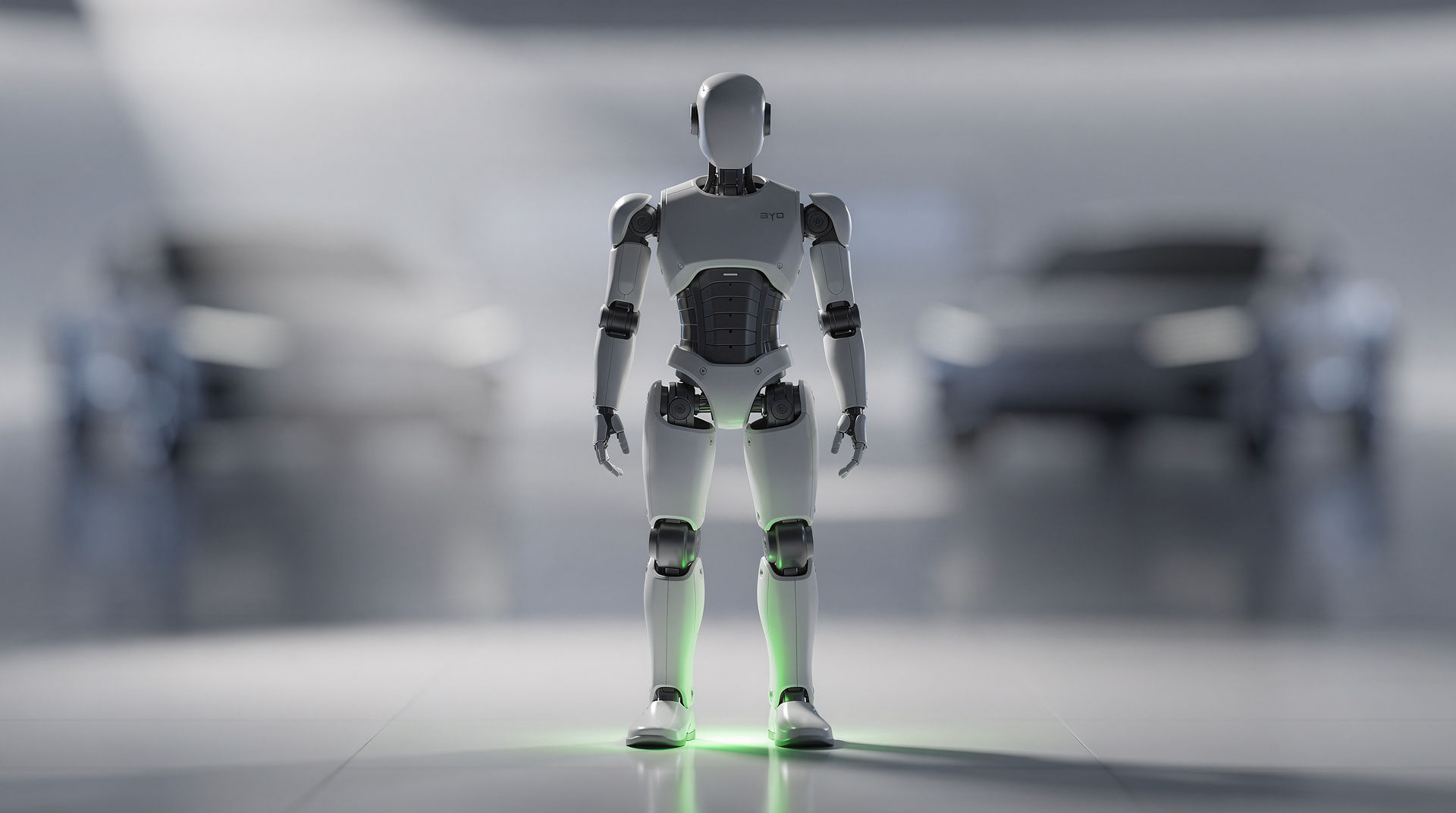
Project "Yao-Shun-Yu" reveals China's most powerful manufacturer is now building humans
In a nutshell
From Electric Cars to Walking Machines
The company that dethroned Tesla in global electric vehicle sales has a new ambition: building humanoid robots. BYD, China's largest new-energy vehicle manufacturer, has officially confirmed it is developing humanoid robots under a project codenamed "Yao-Shun-Yu" — initiated in 2022 and operating under its 15th Business Unit, which focuses on electronic integration and intelligence. The confirmation came from BYD Executive Vice President Li Ke in a recent interview, ending months of speculation about the company's robotics ambitions.
The strategic logic is straightforward. BYD executives argue that automotive AI and humanoid robotics share common technological foundations — and that if humanoid robots eventually become consumer products, the company could leverage its vast dealership network as a sales channel, potentially pursuing an open robotics platform that develops its own products while partnering with other robotics firms. In other words: the same showrooms selling BYD electric cars could one day sell BYD robots.
A Race Already at Full Speed
BYD is entering a field already crowded with Chinese competitors — and the pace of commercialization is striking. Chery's robotics arm launched online consumer sales for its Mornine M1 humanoid robot in April 2026, priced at approximately 280,000 yuan ($41,400 USD), making it one of the first major automakers to publicly commercialize the technology. XPeng plans to mass produce its IRON humanoid by the end of 2026, and Tesla has already deployed 50 units of its Optimus Gen-3 at its Shanghai factory.
The price differential between Chinese and American robots is already becoming a defining competitive factor. The Unitree G1 — China's most affordable full humanoid — costs $16,000, compared to Tesla's Optimus estimated at $30,000 and Boston Dynamics' Spot at $74,500. If BYD applies its proven EV playbook — aggressive manufacturing scale, state backing, and relentless cost reduction — to humanoid robots, the implications for the global robotics industry could be as disruptive as its entry into electric vehicles.
China's Structural Advantage: Patents, Production, and State Capital
The broader context behind BYD's move reveals a structural advantage that goes far beyond any single company. China registered 5,688 humanoid robotics patents between 2020 and 2025 — nearly four times the US total of 1,483, according to the World Economic Forum. China installed approximately 276,000 industrial robots in 2023 alone — 51% of the global total — and robot density has already surpassed Germany, placing China third globally behind only South Korea and Singapore.
The funding model reinforces this advantage. Unlike the US, where robotics investment is primarily venture-driven, China's robotics sector benefits from a hybrid model combining state capital with strategic private investors — giving Chinese firms both longer investment horizons and insulation from market volatility. With BYD now entering the race, the humanoid robot sector has gained its most formidable manufacturing backer yet.
Sources: TechNode, Pandaily, CnEVPost, CarNewsChina, eWeek, OnOff.gr, World Economic Forum, International Federation of Robotics
Strategic Analysis — For Members Only
🔒 This analysis is for watchchina.ai Intelligence members only.
Already a member? Log in here