
“You Don’t Need God to Write Your Email”: China’s Plan to Win AI by Not Trying to Win
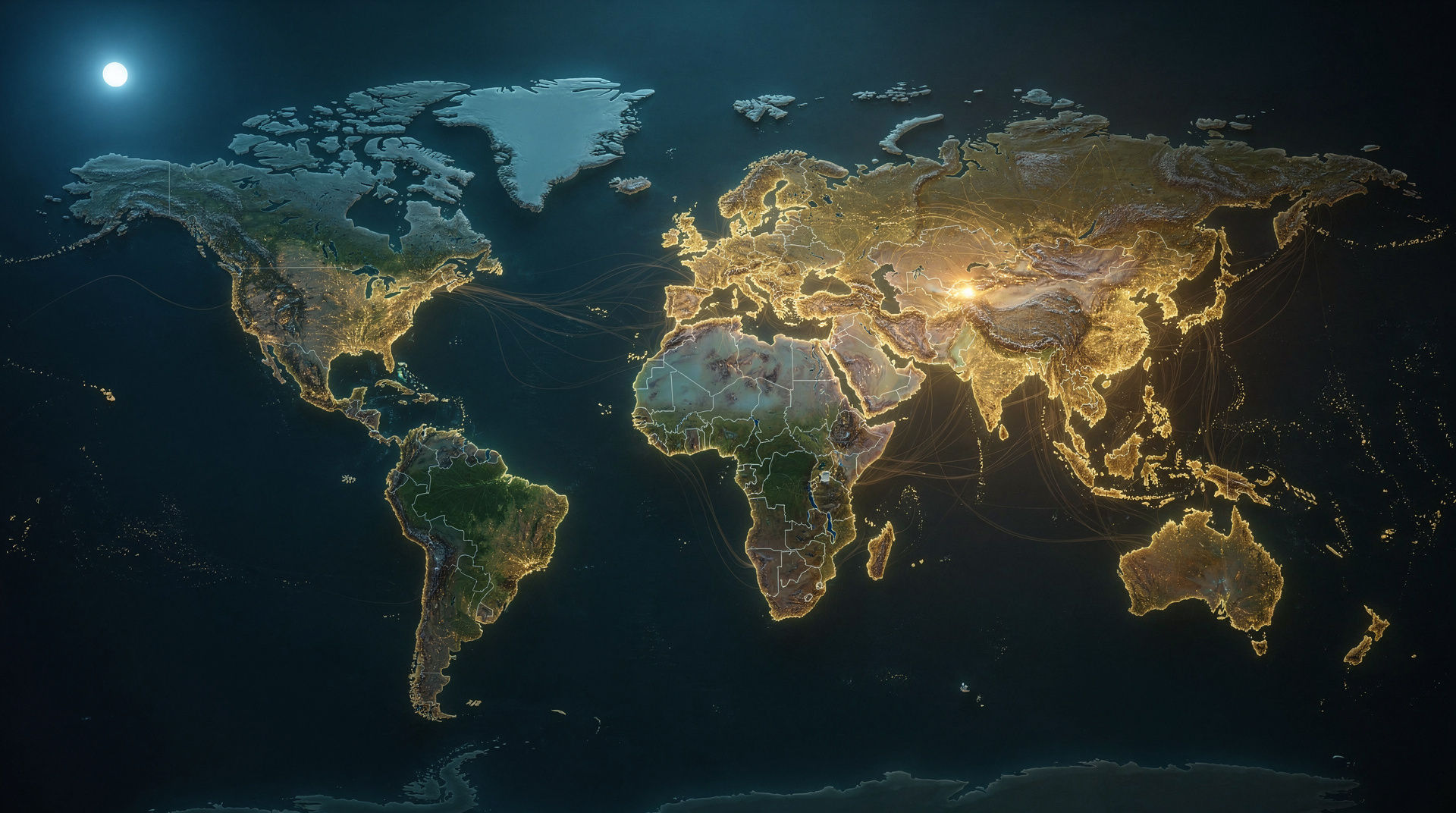
While America races to build the most powerful AI, China is building the cheapest — and quietly turning "good enough" into the default operating system of the planet
In a nutshell
China isn't trying to build the best AI. It's trying to build the default AI — and that may be the smarter bet entirely.
Our members-only forecast explains why Chinese open models will become the default infrastructure across the Global South by 2028, why America's coming counter-offensive will arrive too late and too small, and how China will neutralise its one real weakness — data security — to crack open the regulated-enterprise market it currently can't reach.
A Different Race Entirely
The most important shift in the global AI competition in 2026 is not technological. It is strategic — and it involves China deciding, deliberately, not to compete on the terms America has set. Chinese AI leaders increasingly see themselves running a different race than their American counterparts, focused not on developing the most sophisticated capabilities, but on offering "good enough" models at cheaper prices that will proliferate more widely.
The logic is captured perfectly in a single remark from an American developer who switched from a premium US model to a Chinese one. "You don't need God to write your email," developers say of DeepSeek — good enough for a fraction of the cost. The numbers behind that sentiment are staggering. For one San Diego developer, an hourlong coding session that cost about $10 on Claude cost less than 50 cents on DeepSeek — and he now uses the Chinese model for everything from coding to building software to manage his family's bank accounts.
The Cost Advantage Is Structural, Not Temporary
The instinctive Western dismissal of Chinese pricing — that it is a subsidised loss-leader designed to grab market share before prices rise — misunderstands the foundations of the advantage. Chinese AI models run at roughly one-sixth to one-quarter the cost of comparable American systems, according to a RAND report, with DeepSeek's API pricing at approximately $0.028 per million tokens — roughly 1/180th of equivalent GPT pricing.
This cost advantage isn't a temporary subsidy or a pricing war tactic. It's structural, rooted in algorithmic efficiency: MoE architecture, multi-head latent attention for memory compression, and multi-token prediction that dramatically reduce how much compute each query requires.
This is where the spending asymmetry that watchchina.ai has tracked all month becomes a genuine strategic liability for the United States. America's Big Four hyperscalers have collectively announced AI spending exceeding $650 billion in 2026 alone, with total US AI compute infrastructure spending projected to surpass $2.8 trillion by 2029 — while China's AI ecosystem produces comparable models at a fraction of that investment. If the US is spending more to produce less widely-adopted products, the spending itself becomes a strategic question rather than a strategic answer. Build for perfection, or build for diffusion — and China has chosen diffusion.
The Global South Is Already Choosing
The real battleground for this strategy is not Silicon Valley or Brussels. It is the dozens of emerging economies that need functional, affordable AI and have no ideological stake in which superpower provides it. China is quietly building an ecosystem of open-source models that are both cheap and good enough for most use cases — and by the time Western capitals notice, Chinese AI models may well have become global standards and prove hard to displace, even by more advanced technology.
The political dimension only sharpens China's edge. Washington frames global AI competition as a national security race to be won against China, with no offerings to third countries needing cost-effective, good-enough tools — and as the US has become more erratic and unpredictable, global south leaders have plenty of reason to think relying on Chinese AI could be safer in the long term than dependency on US technology. The conclusion that watchchina.ai readers have seen building for weeks now arrives with full force: China does not need to dominate the most advanced models to win the AI race. If Chinese models become the affordable, good-enough default across emerging markets, Beijing will have built durable influence for decades.
There is, of course, a genuine vulnerability in China's approach — one watchchina.ai will not gloss over. Large companies in regulated industries remain reluctant to use Chinese models due to concerns about data security, censorship, and geopolitical risk, and Chinese AI companies face major hurdles converting popularity into revenue. Winning market share is not the same as winning profit, and the data-security question is real. But strategically, the distinction may not matter. Influence, standards, and dependency are the currency China is accumulating — and those compound for decades, long after the question of who built the smartest model has been forgotten.
Sources: The Washington Post, Rest of World, Foreign Policy, RAND, Digital in Asia, Fortune, Brookings Institution
Strategic Analysis — For Members Only
🔒 This analysis is for watchchina.ai Intelligence members only.
Already a member? Log in here